Friday, 5 October 2012

The Underground War on the Somme


Earlier this year I posted about the archaeological work being done at The Glory Hole positions at La Boiselle on the Somme. Work has been continuing to 'dig' this area all summer both above and below ground. Now this video is available to give you a real understanding of the conditions endured by those involved in the underground war on the Somme.
http://www.bbc.co.uk/news/uk-19839827

For further reading about this aspect of WW1 try;

Sebastian Faulks - 'Birdsong'

Beneath Flanders Field - here

Thursday, 20 September 2012

The Crimean War


Below are some links which will help you build up your understanding of key aspects of the war in the Crimea.

An excellent site from the National Archives, including many original sources... http://www.nationalarchives.gov.uk/battles/crimea/

Britishbattles.com has detailed information on each of the main battles - http://www.britishbattles.com

A TV documentary on the war - http://www.youtube.com/watch?v=Pqik0WDMDco&noredirect=1

An interesting article on the use of the Telegraph during the war - http://distantwriting.co.uk/telegraphwar.html

Don't forget to search the blog for previous postings on the Crimean War!

Monday, 21 May 2012

Final advice for the exam...


With 24 hours to go, there is still time to do some last minute cramming!

At this point, focus your revision on the areas you are still less sure about. You don't have enough time to do everything; you know the stuff you know; therefore use your time to add to your knowledge in those areas which still have a few gaps.

Also spend a little bit of time reading through the advice in the links at the top of the page on how to answer the questions. No doubt you will have spent a lot of time doing past exam questions this year so just remind yourself of how you should be answering Qa and Qb. Each question has different Assessment Objectives, so make sure you know what you should be looking for in each question.

Finally, some general tips for the exam...

1. Plan your answers before you start writing. Take 10 minutes to carefully read and review each of the sources and produce a plan. This will ensure you don't rush into your answer. do this for each question.

2. If you allow 10 to plan each question, then the number of marks is proportional to the time you have (20 marks = 20 minutes). Keep an eye on the clock!

3. Use the sources as the basis of your answer. This will help keep you focused. Remember to give examples from the sources to support your argument.

4. Develop inferences (what does the source suggest to you?) and support these with evidence.

5. Always sum up your argument in a conclusion which clearly addresses the question!

Good luck!


Monday, 7 May 2012

The eyes of the Army - 1914...

This article discusses the role of the Royal Flying Corps, formed 100 years ago.

http://www.bbc.co.uk/news/magazine-17954439

Also from the BBC History team is an excellent article on the development of the British Army between 1916 and 1918. It focuses on 9 key areas including artillery and new technologies. Well worth a read!

http://www.bbc.co.uk/history/worldwars/wwone/gallery_tactics_01.shtml

Friday, 3 February 2012

Online Revision Quizzes


Hodder have recently published online some excellent revision quizzes for the Experience of Warfare Unit. All will test your knowledge of the key units allowing to you build on the strength and weaknesses within your understanding. My advice is to start using them regularly to help develop the depth of your subject knowledge.

http://www.hodderplus.co.uk/myrevisionnotes/a-level-history/the-experience-of-warfare/index.asp

Monday, 12 December 2011

WW1 Centenary site from the IWM

http://www.1914.org/

2014 will mark 100 years since the outbreak of WW1. This site has been created by the Imperial War Museum to collated resources and information surrounding that centenary event.

Already it has lots of great WW1 resources, including some excellent podcasts on various aspects of the war.

http://www.1914.org/podcasts/


Friday, 11 November 2011

Thankful Villages in WW1

At the end of the Great War there were just 52 'Thankful Villages' in Great Britain. These were towns and villages which had had all of their soldiers return home alive. By 1945 the number of villages which had survived both World Wars without loss had fallen to just 14. For the remainder of the country, war memorials would spring up to commemorate those who had lost their lives in the World Wars. Read a detailed account here...

http://www.bbc.co.uk/news/magazine-15671943

The UK National Inventory of War Memorials allows you to search for your nearest war memorial.

http://www.ukniwm.org.uk/

Thursday, 10 November 2011

WW1 archaeology project - La Boiselle


I have posted about the archaeological study at La Boiselle a few times now, and have now found the website of the group carrying out the dig. It is well worth a visit and is updated regularly. It is very rare to be able to excavate a site of such importance as the 'Glory Hole' and the stories, images and finds are quite remarkable.

Interesting also for those with an interest in achaeology.

http://www.laboisselleproject.com/

Thursday, 3 November 2011

WW1 Tunnels under the Somme


As work continues on the archaeological dig on the 'Glory Hole' sector at La Boiselle on the Somme, this BBC news item documents some of the work done so far. a fascinating insight into the underground war of camoflets and crumps fought more than 90 years ago.

http://www.bbc.co.uk/news/world-europe-15568539

Saturday, 23 July 2011

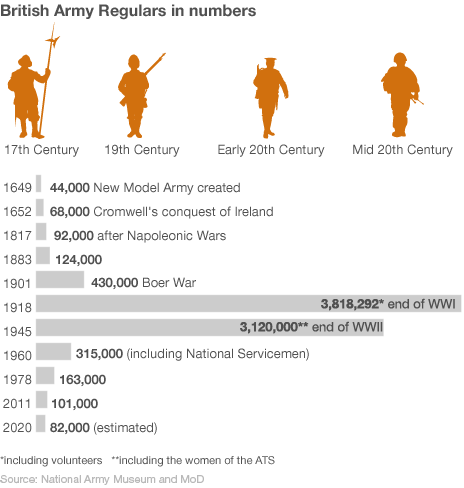
The British Army - is size important?

Following recent announcements that the size of the British Army is to be cut, this article from the BBC looks at the issues of size for the British Army since its formation in 1649.


Read the full article here... http://www.bbc.co.uk/news/magazine-14218909

About Me

My photo
Blog created and maintained by Mr Bendry and students from Frome Community College